


Minister
“Nothing Can Separate Us“
Romans 8: 31–39
To join with us by watching our online worship, please click here.
When Deb was talking last fall about doing this series after visiting Greece and seeing these places that Paul wrote to, I thought – I’ve never been to Greece or visited those places… I guess I will just find pictures online for my week!!
And then she suggested recently that during my week I could use a reading from Romans, and I thought ohhh! I have even been to Rome! And I have pictures I can share! I love show and tell!!
And then as I was thinking about it, I realized that it was this very day, May 17, three years ago that I was in Rome to begin my battlefield tour through Italy with the Seaforth Highlanders and I took this photo. (It was also the day that I bought this stole – another interesting story… ask me about it sometime if you haven’t heard it – for those of you reading this online, I did tell the story in worship and here is the link to me sharing it: https://youtu.be/ZNCYKWxeuDA?si=-taulh9TTwgC8KSw&t=1605 ) And then by pure coincidence, last year on this very day, May 17, my daughter Angela was also in Rome on a post university graduation trip, and she took the same picture in front of the Colosseum that I had taken exactly two years before, to the day.
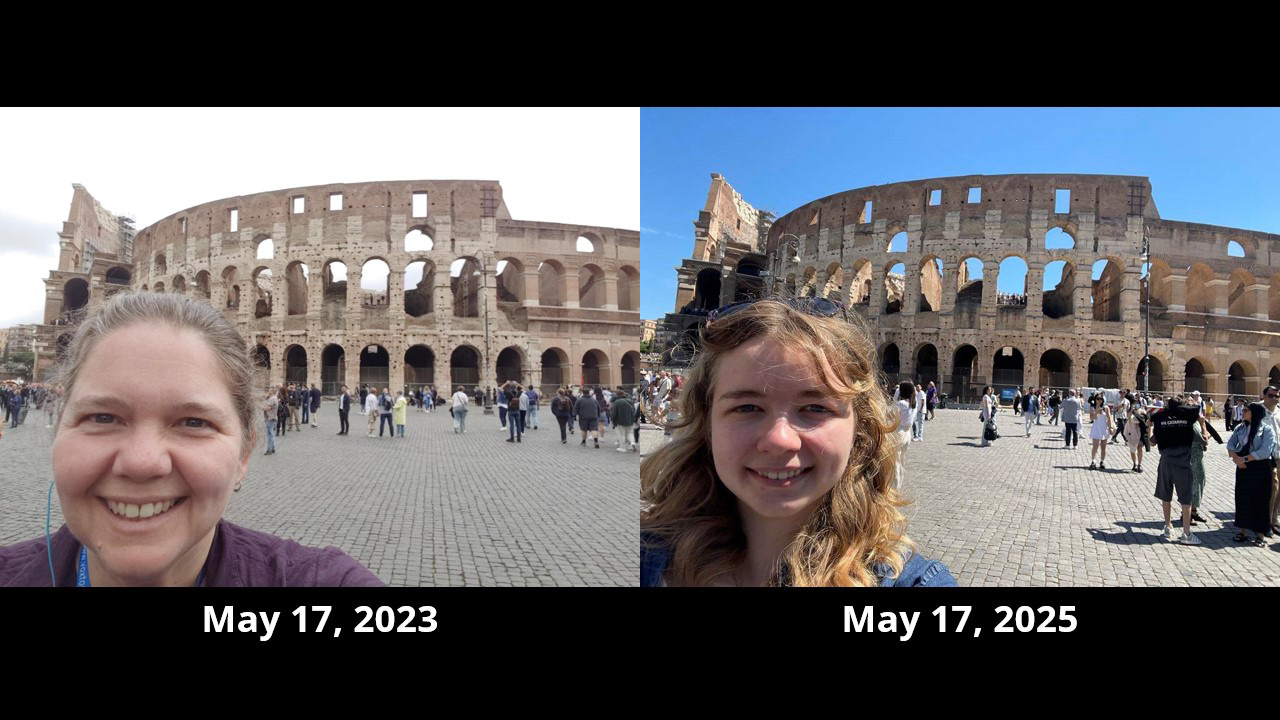
So – it seems fitting that I would use a Romans passage for my portion of this series on Paul and his letters.
And maybe more than just fitting… maybe it’s a reminder of how these ancient words travel.
From a letter written to a small community in Rome, to a photograph taken in front of the Colosseum, to this moment, here, today.
Because sometimes scripture doesn’t stay “back there.”
Sometimes it finds its way into our lives in very particular moments, sometimes even in the very weeks when we most need it.
There are some weeks when you come to a text like this… and it feels less like something to explain and more like something to hold onto.
This is one of those weeks.
It has been a week marked by grief in our wider community. A week where life feels fragile.
Where loss is not abstract, but close, and real, and heavy.
Earlier this week, I had the privilege of presiding at dear Bonnie Wudrick’s memorial and then the next day for Nancy Farahani’s memorial, a service shaped by deep sorrow and deep love, after the tragic death of a woman at the hands of her own son.
And perhaps not by accident, this was one of the passages that I turned to then as well, that I read during her memorial service.
These words from Romans, words that don’t try to explain tragedy, but dare to speak of a love that refuses to let go even in its midst.
And I suspect that many of us come into this space today carrying things, some visible, some hidden, griefs that are fresh, worries that linger, questions that don’t have easy answers.
And into a week like this, we hear these words from Paul: What can separate us from the love of God?
Now, it helps to remember that Paul is not writing from a place of comfort or distance.
And, just as a small aside, when we say “Paul,” we’re also stepping into a bit of ongoing conversation.
Scholars generally agree that Romans is one of the letters Paul himself almost certainly wrote.
But not all the letters in the New Testament that bear his name are universally agreed upon.
Some were likely written by later followers, carrying forward his theology and voice.
So when we read Paul, we’re not just hearing one person, we’re hearing a tradition, a movement, a community shaped by his witness.
(Which, if you’ve ever tried to write something meaningful and then had someone else try to continue it later… you know that can get interesting.)
But Romans… Romans is widely considered authentically his. And you can feel it. It has a kind of depth, a kind of urgency, a kind of careful thought woven with deep conviction.
When he writes this letter, he is writing to a community he has never met, a small group of Christ-followers living in the heart of the empire, in Rome.
Rome was not just another city. It was the centre of everything – political power, military strength, economic control. It was a place where the emperor was declared “lord,” where loyalty to the empire shaped daily life, where status and hierarchy defined your worth.
And into that world, this small, diverse community of Christians was trying to live out a different story. A story about a crucified and risen Christ. A story about love that does not dominate, but serves. A story about belonging that crosses boundaries of class and culture.
It was not easy.
There were tensions within the community, between Jewish and Gentile believers. There were pressures from the outside, to conform, to fit in, to stay quiet. And while the large-scale persecutions we often imagine came later, there was already a sense of vulnerability. A sense that following Christ could cost you something. And Paul knows something about that.
By the time he writes this letter, his life has already been marked by hardship. He has been arrested. He has faced opposition. He has lived with uncertainty about what comes next.
So when he writes about hardship and distress and danger, he is not speaking theoretically.
He is speaking from lived experience. And that matters. Because Paul does not pretend that faith protects us from the hard parts of life. He doesn’t say: “If you trust God, nothing bad will happen.” He doesn’t say: “If you believe strongly enough, everything will work out.” (And if he did, we might be a little suspicious of him.)
Instead, he names what is real. He names hardship. He names distress. He names grief. He names fear. And that, in itself, is a kind of grace. Because it means we don’t have to pretend either. We don’t have to come into this space with everything held together. We don’t have to hide the parts of our lives that feel uncertain or broken. Faith, at least as Paul understands it, is not about avoiding reality. It is about being honest within it.
So Paul asks this question: What can separate us from the love of Christ? And I think it’s important to hear that question as a real question. Because if we’re honest, we might have our own answers. Grief can feel like separation. Loss can feel like separation. Illness can feel like separation. Regret can feel like separation. Even silence… when prayers seem unanswered… can feel like separation. There are moments in life when it feels like something has been torn.
When connection feels fragile. When presence feels distant. When we wonder quietly, or maybe not so quietly…Where is God in all of this?
And it is into that very human place that Paul speaks. Not with a neat explanation. Not with a tidy answer. But with a conviction. No… in all these things… we are more than conquerors through the one who loved us. Now, that phrase “more than conquerors” can be misleading if we hear it through the lens of power or victory. Because this is not about winning.
It’s not about overcoming grief as if it were an obstacle. It’s not about rising above suffering as if we could simply leave it behind. That’s not how life works. And it’s not what Paul means.
The word Paul uses here is closer to something like: held, sustained, carried through. Not untouched by hardship but not abandoned within it. And then Paul does something almost poetic. He begins to name everything he can think of. Death. Life. Angels. Rulers. Things present. Things to come. Powers. Height. Depth.
It’s as if he is searching the edges of human experience, looking for anything that might break the connection between us and God’s love. He reaches as far as he can, across time, across space, across all the known forces of the world. (You can almost imagine him pausing and thinking, “Have I missed anything?”) And then he says: Nothing. Nothing can separate us from the love of God. Not even death.
And we need to be careful here. Because this is not a denial of death’s reality. It is not a way of softening grief or making loss feel smaller. Death is real. Loss is real. Grief is real. We feel it in our bodies. We carry it in our hearts. We live with its absence. Paul is not denying any of that.
What he is saying is something deeper: That even death does not have the final word.
That even death cannot undo the love of God. That even death cannot break the bond that holds us.
In a week like this, that matters. Because we will gather in spaces of grief. We will speak words that feel both necessary and insufficient. We will hold stories; stories of love, of life, of relationship. We will sit in silence that says more than words can. And in those moments, we don’t pretend everything is okay. But we do bear witness to something. We bear witness to love.
To the love that was shared in a life. To the love that continues in memory and connection.
To the love of God that holds what we cannot hold on our own. And maybe this is where the text begins to turn gently toward us. Because if it is true that nothing can separate us from the love of God…then that love is not just something we receive. It is something we are invited to live.
To embody. To practice, especially in messy times. Because we live in a world that knows a lot about separation. We see it everywhere. Division. Isolation. Fear of difference. Quick judgments. Broken relationships.
It doesn’t take much for people to be pushed to the margins.
It doesn’t take much for connection to fray.
And into that kind of world, this text offers a different way.
A way rooted in love that does not let go.
So what might it look like for us to live that kind of love?
It might look like staying when it would be easier to walk away. It might look like listening when we don’t fully understand. It might look like showing up for one another in quiet, ordinary ways. It might look like sitting with someone in their grief, not trying to fix it, not trying to explain it, but simply being present. It might look like patience. Gentleness. Compassion.
Small things, perhaps. But not insignificant. Because these are the ways love takes shape in the world. And maybe this is the invitation this morning. Not to resolve everything. Not to make sense of what cannot yet be understood. But simply to notice: Where do you need to be held right now? Where has this week been heavy? What are you carrying?
And then, gently, to hear this promise again: That there is nothing… nothing in life or in death, nothing in what has been or what is yet to come… that can separate you from the love of God.
Not your grief. Not your questions. Not your fears. Not even death itself. You are held.Held in a love that is deeper than we can fully comprehend. Steadier than the ground beneath our feet.
More enduring than anything that threatens to pull us apart. And that love… is not far away.
It is here. In this moment. In this community. In the quiet spaces where words fall short. Already here. Holding us. Carrying us. And, in time, leading us gently forward. Amen.