


Minister
“The Faith That Wouldn’t Go Away”
Matthew 15:10–28
To join with us by watching our online worship, please click here.
I have to confess… If I were editing the Bible this story might not have made the final draft. It’s uncomfortable. And honestly, if this were a council meeting, I’m not sure this would have survived the agenda review.
Jesus ignores a desperate mother. The disciples want her sent away. Jesus says he was sent only to Israel.
Then comes the line that makes many of us cringe: “It isn’t fair to take the children’s food and throw it to the dogs.”
We hear that and immediately think… “Jesus…what are you doing?” It doesn’t sound like the Jesus who welcomed children. The Jesus who ate with tax collectors. The Jesus who touched lepers. The Jesus who told us to love our neighbours.
And maybe that’s exactly why Matthew kept the story. Because faith isn’t only about the passages we find easy. It’s also about staying with the ones that make us uncomfortable.
The woman in this story is called a Canaanite. And if you’ve been around the Bible for a long time, you may know what that means. But if you haven’t, you might hear “Canaanite” and think it’s simply an ancient nationality. It’s more complicated than that.
The Canaanites are part of Israel’s ancient story. In the Hebrew Bible, they are the people living in the land that the Israelites believe God has promised to them. They are portrayed as ancient enemies, people on the other side of a very old boundary.
By the time Jesus lived, there weren’t really people walking around introducing themselves as “Canaanites.” Matthew is using an old name on purpose.
It’s a bit like identifying someone today by an old conflict and saying, “You know, those people.” The people our ancestors fought. The people our stories taught us to distrust. The people who belong on the other side of the line.
Matthew could have called her a Syrophoenician woman, as Mark does. Instead, he reaches back into Israel’s ancient memory. The old enemies. The old boundaries. The old divisions.
It’s almost as if Matthew is saying, “If you were looking for someone completely outside the circle, this is her.” And Matthew really doesn’t leave us much room for misunderstanding. She’s not just visiting from the next town over. She’s not someone who wandered into the wrong Bible study. She represents the other side. She is a woman. She is a Gentile. She is a Canaanite. She is not part of the Jewish community.
And yet… she knows exactly who Jesus is. “Lord.” “Son of David.” She isn’t supposed to know those titles. She isn’t part of the covenant. She hasn’t studied in the synagogue.
And yet somehow… she sees something many others have missed. She simply cries, “Have mercy on me.” Jesus says nothing. Silence.
Have you ever prayed into silence? Asked for healing… for answers… for someone you love… and heard nothing? Sometimes that silence is almost harder than “no.” You wonder if you’ve been heard. You wonder whether your prayer matters. You wonder whether you should keep going. The woman could have walked away.
Instead…she keeps coming.
The disciples become uncomfortable. “Send her away.” Not because they dislike her necessarily. She’s simply becoming inconvenient. She’s making a scene. She’s disrupting the day. And I suspect the disciples are thinking something like, “Jesus, we’ve got a schedule here.” Which, if you’ve ever been involved in church, is a surprisingly relatable response. Someone else’s pain interrupts our plans. Our schedules. Our comfort. Someone else’s crisis asks something of us that we weren’t prepared to give.
It’s easier to make the problem disappear than to sit beside it. We see this in all kinds of ways. We see it when a person experiencing homelessness becomes an inconvenience rather than a neighbour.
When someone seeking asylum is reduced to a number or a political argument. When someone struggling with addiction is treated as a problem to be removed rather than a person whose life has become complicated. When someone is grieving and we don’t know what to say, so we cross the street emotionally because their pain makes us uncomfortable. When a neighbour’s mental health struggles become something we’d rather not talk about. Or when the effects of climate change, wildfire, drought, extreme heat, feel easier to think about as somebody else’s problem because dealing with them asks something of all of us.
“Send her away.”
Sometimes those words are spoken out loud. More often, they’re expressed through our silence, our policies, our assumptions, or simply our decision to keep walking.
Then comes Jesus’ difficult response. Scholars have wrestled with these words for centuries.
Was Jesus testing her? Was he speaking ironically so the disciples would hear their own prejudice? Was Matthew showing Jesus’ mission expanding? Did this encounter genuinely change something?
Faithful Christians have understood this passage in all of those ways. And perhaps that’s okay. Not every difficult text needs to be solved before it can speak to us.
Sometimes we can spend an extraordinary amount of time trying to make a difficult verse less difficult. Sometimes the better question is simply: “What is this asking of us?”
Whatever is happening… the woman refuses to be discouraged. “Even the dogs eat the crumbs.” What a remarkable answer. She doesn’t walk away. She doesn’t accept the boundary that has been placed around her. She trusts that God’s mercy is bigger than the circle other people have drawn. And… she is persistent.
I suspect if the disciples had a church board meeting after this encounter, someone might have put “Canaanite woman” under “new business.” But she doesn’t care about the agenda. Her daughter needs help. So she keeps asking. I wonder if that’s what faith often looks like. Not certainty. Persistence.
Showing up one more day. Praying one more prayer. Trying one more time. Trusting that grace still exists even when we cannot yet see the whole loaf.
There are people who live this kind of faith all around us. Not loud faith. Not flashy faith. Just people who quietly keep loving. Keep serving. Keep praying. Keep hoping.
One of the things I love about ministry is that I get to meet people with persistent faith.
Sometimes it is the person who keeps showing up to visit a spouse in long-term care. Sometimes it’s the person who has been disappointed by the church but still can’t quite give up on God. Sometimes it’s the parent who keeps advocating for a child who doesn’t fit easily into the systems around them. Sometimes it’s the person who has been told, explicitly or implicitly, that they don’t really belong, and yet they keep looking for a place where they can belong.
Sometimes I think these people teach me more about God than any theology book.
Perhaps you’ve known people like that too. Maybe you’ve been one of them.
Eventually Jesus says, “Woman, great is your faith.” There are only a handful of people Jesus praises for having great faith. Most of them aren’t the people you’d expect. A Roman centurion. A Canaanite woman. Outsiders. People who weren’t supposed to be the heroes. Matthew seems to delight in that irony. The kingdom keeps appearing in unexpected places. And perhaps that’s something we need to remember whenever we start thinking we know where God is going to show up. God has a habit of surprising us.
The person we dismiss may teach us something. The stranger may become a neighbour. The outsider may become a beloved member of the community. The person we thought needed to be welcomed may turn out to be the person who teaches us what welcome looks like.
I wonder where we might encounter that kind of faith today. Perhaps in a refugee family beginning again in a new country. Perhaps in a teenager standing up for someone being bullied. Perhaps in someone quietly sitting beside a hospital bed. Perhaps in the person organizing meals for neighbours after a wildfire. Perhaps in the firefighters and emergency responders who keep showing up while communities are evacuated around them. Perhaps in someone who has spent years searching for God and still whispers, “Have mercy.” Perhaps in someone who has never set foot in a church but spends their life caring for other people.
Faith has a way of appearing where we least expect it. And maybe there is one more question this story asks us. What do we do when our understanding of God’s welcome becomes bigger? Because that’s not always comfortable either. It’s easy to talk about welcoming everyone until “everyone” includes someone who challenges our assumptions. Until they vote differently. Until they worship differently. Until they speak a different language. Until they have a different understanding of family. Until they don’t believe what we believe. Until they ask us to reconsider something we’ve always assumed was true.
The Canaanite woman doesn’t simply receive a place at the table. She helps reveal that the table was bigger than the disciples thought it was. And perhaps that’s what happens in a living faith community. We think we know the boundaries. And then someone comes along and asks us to redraw them.
And I think that question matters particularly for us as a church. At Mount Seymour United, we talk about Being Community, Living Generously, and Nurturing Spirit. Those aren’t just nice words. They are a way of asking what kind of community we want to be.
Do we want to be a church where people already know the rules and understand how everything works? Or do we want to be a church where someone can walk through the doors carrying questions, doubts, a different faith tradition, no faith tradition, a complicated history with religion, and still hear, “There’s a place for you here.”
Do we want to be a church that simply welcomes people who already know how to be church? Or do we want to be willing to learn from the people who don’t?
Because the Canaanite woman doesn’t come to Jesus already knowing the right answers. She comes with a need. She comes with persistence. And she teaches.
That might mean listening more carefully to the person who says, “I’ve never felt comfortable in church.” Instead of immediately explaining why they should feel welcome, perhaps we listen to why they haven’t. It might mean listening to younger people who experience the world differently than we do. It might mean listening to newcomers to Canada whose experiences and traditions are different from ours. It might mean listening to Indigenous neighbours and communities, not simply asking them to come into our spaces, but being willing to learn what relationship and reconciliation require of us. It might mean making room for people whose understanding of God doesn’t fit neatly into our own. And it might mean recognizing that sometimes the person who challenges us most is the person from whom we have the most to learn.
There is another part of this story that I think matters for our own lives. The woman doesn’t have to become someone else before she can approach Jesus. She doesn’t have to become Jewish. She doesn’t have to learn the right religious language. She doesn’t have to clean herself up first. She comes as she is. She brings her fear. Her love for her daughter. Her desperation. Her faith. Her persistence. And that is enough to begin the conversation.
Maybe that’s good news for us, too. Because sometimes we imagine that we have to get our faith sorted out before we can come to church. We have to know what we believe. We have to pray properly. We have to understand the Bible. We have to be certain about God.
But perhaps faith isn’t always certainty. Perhaps sometimes faith is simply the courage to keep showing up with our questions. To say, “Have mercy.” To say, “I don’t understand.” To say, “I’m not sure I believe this anymore.” To say, “I want to believe, but I’m struggling.” To say, “I don’t know where God is, but I’m still here.”
The Canaanite woman reminds us that persistent faith doesn’t have to look polished. Sometimes it looks like refusing to give up.
And there is something else here for those of us who have been part of the church for a long time. Sometimes we are the people inside the circle. And sometimes we are the people who need to move over. That’s not always easy. We can get very attached to our circles. Our traditions. Our pews. Our familiar ways of doing things. Our favourite hymns. Our preferred ways of worshipping. Our assumptions about what church is supposed to look like.
And, of course, none of us has ever been attached to a particular way of doing something at church. Never. Absolutely not. We are famously flexible. We embrace change with enthusiasm.
But the gospel keeps asking us: What if making room for someone else means changing something that has been comfortable for us? What if the Spirit is calling us not simply to invite more people into the church we already know, but to allow new people to help shape what the church becomes? That is a much more challenging kind of welcome.
So what does this scripture mean for us today? Perhaps it means that when we encounter someone on the margins, we don’t begin by asking, “Do they belong here?” We begin by asking, “What might they have to teach us?” Perhaps it means that when we are the ones standing on the outside, we don’t have to assume that our place there is permanent.
We can keep knocking. Keep asking. Keep seeking. Keep trusting that there is room for us, too. And perhaps it means that when we pray and hear silence, we don’t necessarily have to interpret silence as abandonment. Sometimes faith is simply staying in the conversation.
Perhaps that’s the invitation for us. To listen before we dismiss. To welcome before we judge. To recognize that the people we think have little to teach us may become our greatest teachers. To notice the boundaries we have inherited and ask whether they still belong in the kingdom of God. To make room at our tables. To keep showing up when faith feels difficult. And to remember that sometimes the most persistent faith comes from those who have spent their lives outside the circle.
In the end… this story isn’t really about crumbs. It’s about abundance. The kingdom of God has never been a carefully rationed meal. It is a feast. A feast where there is always room for one more chair. And maybe our calling as a church is not to decide who gets a place at that table…but to keep pulling up chairs. Even when it means rearranging the room a little. Even when somebody says, “But that’s not where we usually put the chairs.” Because if the kingdom of God is a feast, I suspect God is less concerned about whether the seating chart is exactly right…and much more concerned about whether everyone has been fed.
For the newcomer. For the doubter. For the person who has been hurt by the church. For the person who has never been inside one. For the person whose faith looks different from ours. For the person who is tired. For the person who is persistent. For ourselves, when we need to be reminded that we belong too. Because God’s grace is not a limited supply. There is enough bread. Enough mercy. Enough love. Enough room. Always enough for one more. Thanks be to God.
Amen.
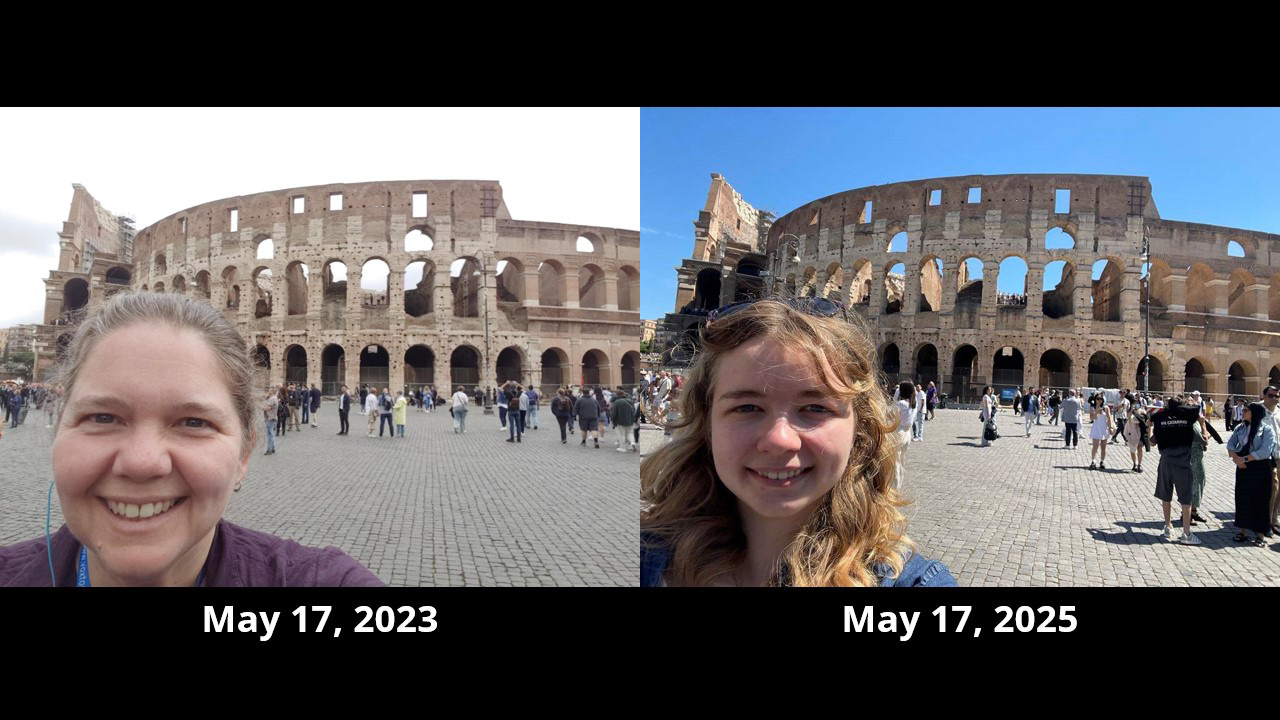
So – it seems fitting that I would use a Romans passage for my portion of this series on Paul and his letters.
And maybe more than just fitting… maybe it’s a reminder of how these ancient words travel.
From a letter written to a small community in Rome, to a photograph taken in front of the Colosseum, to this moment, here, today.
Because sometimes scripture doesn’t stay “back there.”
Sometimes it finds its way into our lives in very particular moments, sometimes even in the very weeks when we most need it.
There are some weeks when you come to a text like this… and it feels less like something to explain and more like something to hold onto.
This is one of those weeks.
It has been a week marked by grief in our wider community. A week where life feels fragile.
Where loss is not abstract, but close, and real, and heavy.
Earlier this week, I had the privilege of presiding at dear Bonnie Wudrick’s memorial and then the next day for Nancy Farahani’s memorial, a service shaped by deep sorrow and deep love, after the tragic death of a woman at the hands of her own son.
And perhaps not by accident, this was one of the passages that I turned to then as well, that I read during her memorial service.
These words from Romans, words that don’t try to explain tragedy, but dare to speak of a love that refuses to let go even in its midst.
And I suspect that many of us come into this space today carrying things, some visible, some hidden, griefs that are fresh, worries that linger, questions that don’t have easy answers.
And into a week like this, we hear these words from Paul: What can separate us from the love of God?
Now, it helps to remember that Paul is not writing from a place of comfort or distance.
And, just as a small aside, when we say “Paul,” we’re also stepping into a bit of ongoing conversation.
Scholars generally agree that Romans is one of the letters Paul himself almost certainly wrote.
But not all the letters in the New Testament that bear his name are universally agreed upon.
Some were likely written by later followers, carrying forward his theology and voice.
So when we read Paul, we’re not just hearing one person, we’re hearing a tradition, a movement, a community shaped by his witness.
(Which, if you’ve ever tried to write something meaningful and then had someone else try to continue it later… you know that can get interesting.)
But Romans… Romans is widely considered authentically his. And you can feel it. It has a kind of depth, a kind of urgency, a kind of careful thought woven with deep conviction.
When he writes this letter, he is writing to a community he has never met, a small group of Christ-followers living in the heart of the empire, in Rome.
Rome was not just another city. It was the centre of everything – political power, military strength, economic control. It was a place where the emperor was declared “lord,” where loyalty to the empire shaped daily life, where status and hierarchy defined your worth.
And into that world, this small, diverse community of Christians was trying to live out a different story. A story about a crucified and risen Christ. A story about love that does not dominate, but serves. A story about belonging that crosses boundaries of class and culture.
It was not easy.
There were tensions within the community, between Jewish and Gentile believers. There were pressures from the outside, to conform, to fit in, to stay quiet. And while the large-scale persecutions we often imagine came later, there was already a sense of vulnerability. A sense that following Christ could cost you something. And Paul knows something about that.
By the time he writes this letter, his life has already been marked by hardship. He has been arrested. He has faced opposition. He has lived with uncertainty about what comes next.
So when he writes about hardship and distress and danger, he is not speaking theoretically.
He is speaking from lived experience. And that matters. Because Paul does not pretend that faith protects us from the hard parts of life. He doesn’t say: “If you trust God, nothing bad will happen.” He doesn’t say: “If you believe strongly enough, everything will work out.” (And if he did, we might be a little suspicious of him.)
Instead, he names what is real. He names hardship. He names distress. He names grief. He names fear. And that, in itself, is a kind of grace. Because it means we don’t have to pretend either. We don’t have to come into this space with everything held together. We don’t have to hide the parts of our lives that feel uncertain or broken. Faith, at least as Paul understands it, is not about avoiding reality. It is about being honest within it.
So Paul asks this question: What can separate us from the love of Christ? And I think it’s important to hear that question as a real question. Because if we’re honest, we might have our own answers. Grief can feel like separation. Loss can feel like separation. Illness can feel like separation. Regret can feel like separation. Even silence… when prayers seem unanswered… can feel like separation. There are moments in life when it feels like something has been torn.
When connection feels fragile. When presence feels distant. When we wonder quietly, or maybe not so quietly…Where is God in all of this?
And it is into that very human place that Paul speaks. Not with a neat explanation. Not with a tidy answer. But with a conviction. No… in all these things… we are more than conquerors through the one who loved us. Now, that phrase “more than conquerors” can be misleading if we hear it through the lens of power or victory. Because this is not about winning.
It’s not about overcoming grief as if it were an obstacle. It’s not about rising above suffering as if we could simply leave it behind. That’s not how life works. And it’s not what Paul means.
The word Paul uses here is closer to something like: held, sustained, carried through. Not untouched by hardship but not abandoned within it. And then Paul does something almost poetic. He begins to name everything he can think of. Death. Life. Angels. Rulers. Things present. Things to come. Powers. Height. Depth.
It’s as if he is searching the edges of human experience, looking for anything that might break the connection between us and God’s love. He reaches as far as he can, across time, across space, across all the known forces of the world. (You can almost imagine him pausing and thinking, “Have I missed anything?”) And then he says: Nothing. Nothing can separate us from the love of God. Not even death.
And we need to be careful here. Because this is not a denial of death’s reality. It is not a way of softening grief or making loss feel smaller. Death is real. Loss is real. Grief is real. We feel it in our bodies. We carry it in our hearts. We live with its absence. Paul is not denying any of that.
What he is saying is something deeper: That even death does not have the final word.
That even death cannot undo the love of God. That even death cannot break the bond that holds us.
In a week like this, that matters. Because we will gather in spaces of grief. We will speak words that feel both necessary and insufficient. We will hold stories; stories of love, of life, of relationship. We will sit in silence that says more than words can. And in those moments, we don’t pretend everything is okay. But we do bear witness to something. We bear witness to love.
To the love that was shared in a life. To the love that continues in memory and connection.
To the love of God that holds what we cannot hold on our own. And maybe this is where the text begins to turn gently toward us. Because if it is true that nothing can separate us from the love of God…then that love is not just something we receive. It is something we are invited to live.
To embody. To practice, especially in messy times. Because we live in a world that knows a lot about separation. We see it everywhere. Division. Isolation. Fear of difference. Quick judgments. Broken relationships.
It doesn’t take much for people to be pushed to the margins.
It doesn’t take much for connection to fray.
And into that kind of world, this text offers a different way.
A way rooted in love that does not let go.
So what might it look like for us to live that kind of love?
It might look like staying when it would be easier to walk away. It might look like listening when we don’t fully understand. It might look like showing up for one another in quiet, ordinary ways. It might look like sitting with someone in their grief, not trying to fix it, not trying to explain it, but simply being present. It might look like patience. Gentleness. Compassion.
Small things, perhaps. But not insignificant. Because these are the ways love takes shape in the world. And maybe this is the invitation this morning. Not to resolve everything. Not to make sense of what cannot yet be understood. But simply to notice: Where do you need to be held right now? Where has this week been heavy? What are you carrying?
And then, gently, to hear this promise again: That there is nothing… nothing in life or in death, nothing in what has been or what is yet to come… that can separate you from the love of God.
Not your grief. Not your questions. Not your fears. Not even death itself. You are held.Held in a love that is deeper than we can fully comprehend. Steadier than the ground beneath our feet.
More enduring than anything that threatens to pull us apart. And that love… is not far away.
It is here. In this moment. In this community. In the quiet spaces where words fall short. Already here. Holding us. Carrying us. And, in time, leading us gently forward. Amen.