


Minister
“Growing Together”
Matthew 13:24–30, 36–43
To join with us by watching our online worship, please click here.
Matthew 13 is one of those passages that sounds simple when we first hear it. There are weeds. There is wheat. Good people. Bad people. End of story.
Except Jesus himself won’t let it stay that simple. He tells a story about a farmer who sows good seed. During the night an enemy comes and scatters weeds among the wheat. By the time the plants begin to grow, the servants are alarmed.
“Should we pull out the weeds?”
It’s a practical question. It makes sense. Weeds steal nutrients. They crowd out the crop. But the farmer says something surprising.
“No. Let both of them grow together until the harvest.”
Not because the weeds don’t matter. Not because the farmer can’t tell the difference. But because pulling too quickly might destroy the wheat as well.
That answer has always made me a little uncomfortable. Because if I’m honest, I rather like sorting things into neat categories. Who’s right. Who’s wrong. Who’s in. Who’s out.
It feels efficient. It feels safe. It gives us the comforting illusion that life is much simpler than it really is. But Jesus rarely offers us simple. The Kingdom of God, Jesus says, is like this. Not perfect. Not tidy. Not free of weeds. But alive. Growing quietly. Patiently. Often in ways we don’t immediately recognize.
Perhaps that’s why Jesus calls it the Kingdom of God and not the Kingdom of Us. Because God’s work is already happening long before we notice it. The invitation is not to create God’s presence in the world. The invitation is to recognize where God is already present. God seems much more comfortable with unfinished people than we are.
This parable made me think of my raspberry patch (because I’ve been enjoying a lot of raspberries lately!). A few years ago once my raspberries were quite well established, morning glory decided it wanted to move in.
Now, if you’ve ever battled morning glory, you know it has ambitions. It doesn’t just grow beside your plants. It wraps itself around them. Climbs through them. Sends roots everywhere.
By midsummer my raspberry canes and the morning glory were so intertwined that it was hard to tell where one ended and the other began.
My first instinct was, “Well, I’ll just pull out the weeds.”
Simple enough. Except it wasn’t. Every time I tugged on a vine, the new shoots dripping with raspberries came with it. Pull too hard and I’d damage the very plants I was trying to protect. So I learned to be patient. I’d snip a vine here. Loosen another one there. Wait until the season ended before tackling the deeper roots. It wasn’t nearly as satisfying as ripping everything out at once. But it meant I actually got raspberries that summer.
As I worked in the garden, I found myself thinking, “Jesus really knew what he was talking about.” Of course, the weed Jesus is talking about wasn’t morning glory. It was probably something called darnel. In its early stages, darnel looks almost identical to wheat. Even experienced farmers sometimes couldn’t tell them apart until much later in the season. Which makes the farmer’s instruction even more understandable.
In my raspberry patch, the problem was that everything was tangled together. In Jesus’ field, the problem was that everything looked the same. Sometimes you honestly can’t tell what you’re looking at.
Either way…Rushing to pull out the weeds could destroy the harvest. And perhaps that’s one of the hardest lessons of faith. We often imagine ourselves as the ones responsible for making God’s kingdom happen. We think it depends entirely on our effort, our wisdom, our ability to get things right. But Jesus reminds us that the field already belongs to God.
The seed is already planted. Life is already growing. Grace is already at work beneath the surface. Our calling is not to force growth. Our calling is to notice it, nurture it, and make room for it. That’s more than an agricultural lesson. It’s a lesson in humility.
Because this isn’t really a story about farming. It’s a story about the human heart. About how quickly we judge. How little we know. And how patient God chooses to be with us all.
How often have we been absolutely certain we knew someone’s story? We’ve decided someone is difficult. Selfish. Closed-minded. Beyond redemption. Only to discover later that we knew almost nothing about what they were carrying. It is the reason we start all our team meetings and small group gatherings with a check in – so that if you had a really hard day or woke up on the wrong side of the bed, or you are celebrating a big win, it might pre-emptively give some understanding about how you might react or respond during the gathering time.
Sometimes all we see is someone’s behaviour. We don’t see the grief beneath it. The diagnosis they haven’t told anyone about. The marriage that’s falling apart. The years spent caring for someone else and ignoring their own needs. The loneliness hidden behind a smile. Or perhaps the courage it took simply to walk through these church doors this morning.
Life has a way of humbling our first impressions. Because the truth is, Christ is often present in places we don’t expect. God is often already working in people before we know their names, before we know their stories, and sometimes even before they know it themselves.
We are not bringing God into someone’s life as though God has been absent. We are discovering the ways God has already been there.
How often have we wanted to clean things up quickly? To fix people. To decide who’s right and who’s wrong. To separate the good from the bad.
But people, like gardens, are rarely that tidy. Our lives become intertwined with one another. Families are complicated. Communities are complicated. Even our own hearts are complicated.
Sometimes, if we rush to pull out what we think doesn’t belong, we end up wounding the very life we’re trying to preserve.
Perhaps that’s why Jesus tells the servants to wait.
Not because the weeds don’t matter. But because love is often more careful than judgement.
We don’t have to look very far to see weeds.
We see wars that seem impossible to end. We hear political leaders speaking past one another instead of listening. We watch outrage become entertainment and social media reward the quickest judgement rather than the deepest understanding.
Even our neighbourhoods can begin to feel divided into “people like us” and “those people.”
Closer to home, we encounter addiction. Loneliness. broken relationships. Prejudice. Poverty. Fear.
Sometimes we look at the state of the world and wonder why God doesn’t simply intervene. Why not put an end to the violence? Remove the hatred? End the greed? Cure every disease? It’s one of the oldest questions of faith.
And Jesus doesn’t really answer it here. But he does suggest something remarkable. God’s first instinct is not destruction. God’s first instinct is patience. God’s first instinct is always to preserve life wherever possible.
Then we realize something uncomfortable. The line between wheat and weeds doesn’t run between “those people” and “us.” It runs through every human heart.
The Russian author and dissident Aleksandr Solzhenitsyn once wrote, ” If only there were evil people somewhere insidiously committing evil deeds, and it were necessary only to separate them from the rest of us and destroy them. But the line dividing good and evil cuts through the heart of every human being. And who is willing to destroy a piece of his own heart?”
Some days we’re generous. Other days we’re impatient. Sometimes we’re courageous. Sometimes fear gets the better of us. Sometimes we’re both before lunch.
Jesus refuses to flatten people into labels because people are more complicated, and far more beloved than labels allow.
Throughout history the Church has often read this parable as permission to identify the weeds. Unfortunately, we’ve sometimes been quicker to judge than to listen. We’ve decided we already know who belongs and who doesn’t. We’ve forgotten that every saint has a past and every sinner has a future.
Yet notice something. In this story the servants never become the judges.
That responsibility belongs to God.
Our calling is not sorting. Our calling is cultivating. Cultivating compassion. Cultivating hope. Cultivating communities where people can grow. Offering a cup of water. Creating the conditions where life can flourish.
If I’m honest, I don’t think Jesus is only warning us about judging other people. I think he’s also warning us about judging ourselves. Some of us spend our lives convinced we’re the weeds. We remember mistakes we made years ago. Words we wish we could take back. Relationships that ended badly. Failures we can’t seem to forgive ourselves for. Yet God keeps seeing wheat where we only see weeds.
God is infinitely more patient with us than we are with ourselves.
I’ve seen that happen here, too. I think about all the people who have walked through these doors over the years. Some arrived carrying grief. Some came angry with the church. Some weren’t even sure they believed anymore. Some simply came because someone invited them for coffee.
If someone had looked at them on that first Sunday, they might not have seen what God already saw. They might have seen uncertainty. They might have seen questions. They might have seen someone who didn’t quite fit.
But God saw something more. God saw possibility. God saw gifts that had not yet been revealed. God saw wheat already growing.
And yet…
Some became members, serving in so many ways. They became volunteers, friends, and a vital part of this community.
Thank goodness nobody decided too quickly what God could or couldn’t do in their lives.
One of the things I love about Mount Seymour is that we’re slowly learning this together.
Think about our Sacred Garden. Some plants flourished immediately. Others struggled. A few had to be replaced. There are still weeds that appear exactly where we’d rather they didn’t. And yes, people notice them. But they aren’t what defines the garden. What people remember is children laughing as they play on the new natural playground. Someone quietly walking the labyrinth. Neighbours sitting on a bench talking. Families gathering in the shade at the table.
People notice life.
Perhaps that’s how the Kingdom of God works too. Not as a perfectly manicured garden. But as a place where grace quietly outgrows fear. Maybe that’s why gardens are such powerful teachers.
A gardener doesn’t create life. A gardener creates the conditions where life can emerge. The seed already carries the mystery of growth within it. The gardener tends. Waters. Waits. Trusts.
Perhaps that is our calling as people of faith too.
One of the greatest gifts we can offer another person is to believe they are more than their worst day. Imagine if someone had given up on Peter after he denied Jesus. Or on Paul before Damascus. Or on Zacchaeus before he climbed the tree. None of them looked particularly promising at first glance. Neither do we, some days. Yet God keeps seeing possibilities we cannot yet see.
Maybe that’s the invitation of this parable. Not to become better at spotting weeds. But to become better at noticing wheat. The goodness still emerging. The healing still unfolding. The courage quietly taking root.
The farmer’s patience isn’t indifference. It’s hope. It’s the confidence that growth takes time. Transformation takes time. Healing takes time.
Anyone who has loved another person knows this. Anyone who has grieved knows this. Anyone who has tried to change themselves knows this.
The good news is not that there are no weeds. The good news is that God has not given up on the field. God has not given up on this world. God has not given up on the Church. God has not given up on your neighbour. And perhaps most importantly… God has not given up on you.
Every day when I arrive home from work and walk by my raspberry patch I’ll pull a few morning glory vines. And I’ll probably grumble a little. I’ll almost certainly eat more raspberries than I planned. And I’ll remember this parable.
I’ll remember that God is far more patient than I am. I’ll remember that God’s kingdom isn’t built by pulling people out of the field. It’s built by noticing where God is already growing. It’s built by nurturing life wherever it appears. Maybe that’s our calling too. To notice the wheat before we point out the weeds. To look for Christ already present. To trust that grace is already growing beneath the surface.
To leave the final sorting to God…and spend our lives helping one another grow.
Thanks be to God.
Amen.
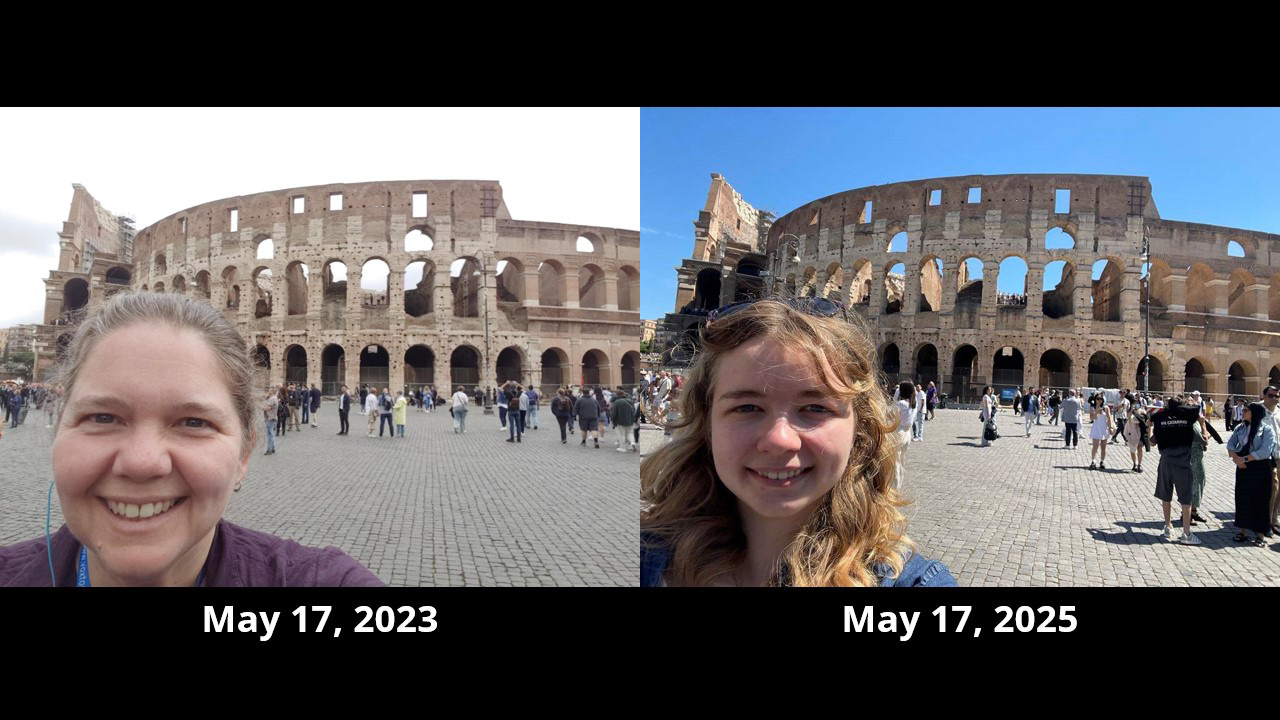
So – it seems fitting that I would use a Romans passage for my portion of this series on Paul and his letters.
And maybe more than just fitting… maybe it’s a reminder of how these ancient words travel.
From a letter written to a small community in Rome, to a photograph taken in front of the Colosseum, to this moment, here, today.
Because sometimes scripture doesn’t stay “back there.”
Sometimes it finds its way into our lives in very particular moments, sometimes even in the very weeks when we most need it.
There are some weeks when you come to a text like this… and it feels less like something to explain and more like something to hold onto.
This is one of those weeks.
It has been a week marked by grief in our wider community. A week where life feels fragile.
Where loss is not abstract, but close, and real, and heavy.
Earlier this week, I had the privilege of presiding at dear Bonnie Wudrick’s memorial and then the next day for Nancy Farahani’s memorial, a service shaped by deep sorrow and deep love, after the tragic death of a woman at the hands of her own son.
And perhaps not by accident, this was one of the passages that I turned to then as well, that I read during her memorial service.
These words from Romans, words that don’t try to explain tragedy, but dare to speak of a love that refuses to let go even in its midst.
And I suspect that many of us come into this space today carrying things, some visible, some hidden, griefs that are fresh, worries that linger, questions that don’t have easy answers.
And into a week like this, we hear these words from Paul: What can separate us from the love of God?
Now, it helps to remember that Paul is not writing from a place of comfort or distance.
And, just as a small aside, when we say “Paul,” we’re also stepping into a bit of ongoing conversation.
Scholars generally agree that Romans is one of the letters Paul himself almost certainly wrote.
But not all the letters in the New Testament that bear his name are universally agreed upon.
Some were likely written by later followers, carrying forward his theology and voice.
So when we read Paul, we’re not just hearing one person, we’re hearing a tradition, a movement, a community shaped by his witness.
(Which, if you’ve ever tried to write something meaningful and then had someone else try to continue it later… you know that can get interesting.)
But Romans… Romans is widely considered authentically his. And you can feel it. It has a kind of depth, a kind of urgency, a kind of careful thought woven with deep conviction.
When he writes this letter, he is writing to a community he has never met, a small group of Christ-followers living in the heart of the empire, in Rome.
Rome was not just another city. It was the centre of everything – political power, military strength, economic control. It was a place where the emperor was declared “lord,” where loyalty to the empire shaped daily life, where status and hierarchy defined your worth.
And into that world, this small, diverse community of Christians was trying to live out a different story. A story about a crucified and risen Christ. A story about love that does not dominate, but serves. A story about belonging that crosses boundaries of class and culture.
It was not easy.
There were tensions within the community, between Jewish and Gentile believers. There were pressures from the outside, to conform, to fit in, to stay quiet. And while the large-scale persecutions we often imagine came later, there was already a sense of vulnerability. A sense that following Christ could cost you something. And Paul knows something about that.
By the time he writes this letter, his life has already been marked by hardship. He has been arrested. He has faced opposition. He has lived with uncertainty about what comes next.
So when he writes about hardship and distress and danger, he is not speaking theoretically.
He is speaking from lived experience. And that matters. Because Paul does not pretend that faith protects us from the hard parts of life. He doesn’t say: “If you trust God, nothing bad will happen.” He doesn’t say: “If you believe strongly enough, everything will work out.” (And if he did, we might be a little suspicious of him.)
Instead, he names what is real. He names hardship. He names distress. He names grief. He names fear. And that, in itself, is a kind of grace. Because it means we don’t have to pretend either. We don’t have to come into this space with everything held together. We don’t have to hide the parts of our lives that feel uncertain or broken. Faith, at least as Paul understands it, is not about avoiding reality. It is about being honest within it.
So Paul asks this question: What can separate us from the love of Christ? And I think it’s important to hear that question as a real question. Because if we’re honest, we might have our own answers. Grief can feel like separation. Loss can feel like separation. Illness can feel like separation. Regret can feel like separation. Even silence… when prayers seem unanswered… can feel like separation. There are moments in life when it feels like something has been torn.
When connection feels fragile. When presence feels distant. When we wonder quietly, or maybe not so quietly…Where is God in all of this?
And it is into that very human place that Paul speaks. Not with a neat explanation. Not with a tidy answer. But with a conviction. No… in all these things… we are more than conquerors through the one who loved us. Now, that phrase “more than conquerors” can be misleading if we hear it through the lens of power or victory. Because this is not about winning.
It’s not about overcoming grief as if it were an obstacle. It’s not about rising above suffering as if we could simply leave it behind. That’s not how life works. And it’s not what Paul means.
The word Paul uses here is closer to something like: held, sustained, carried through. Not untouched by hardship but not abandoned within it. And then Paul does something almost poetic. He begins to name everything he can think of. Death. Life. Angels. Rulers. Things present. Things to come. Powers. Height. Depth.
It’s as if he is searching the edges of human experience, looking for anything that might break the connection between us and God’s love. He reaches as far as he can, across time, across space, across all the known forces of the world. (You can almost imagine him pausing and thinking, “Have I missed anything?”) And then he says: Nothing. Nothing can separate us from the love of God. Not even death.
And we need to be careful here. Because this is not a denial of death’s reality. It is not a way of softening grief or making loss feel smaller. Death is real. Loss is real. Grief is real. We feel it in our bodies. We carry it in our hearts. We live with its absence. Paul is not denying any of that.
What he is saying is something deeper: That even death does not have the final word.
That even death cannot undo the love of God. That even death cannot break the bond that holds us.
In a week like this, that matters. Because we will gather in spaces of grief. We will speak words that feel both necessary and insufficient. We will hold stories; stories of love, of life, of relationship. We will sit in silence that says more than words can. And in those moments, we don’t pretend everything is okay. But we do bear witness to something. We bear witness to love.
To the love that was shared in a life. To the love that continues in memory and connection.
To the love of God that holds what we cannot hold on our own. And maybe this is where the text begins to turn gently toward us. Because if it is true that nothing can separate us from the love of God…then that love is not just something we receive. It is something we are invited to live.
To embody. To practice, especially in messy times. Because we live in a world that knows a lot about separation. We see it everywhere. Division. Isolation. Fear of difference. Quick judgments. Broken relationships.
It doesn’t take much for people to be pushed to the margins.
It doesn’t take much for connection to fray.
And into that kind of world, this text offers a different way.
A way rooted in love that does not let go.
So what might it look like for us to live that kind of love?
It might look like staying when it would be easier to walk away. It might look like listening when we don’t fully understand. It might look like showing up for one another in quiet, ordinary ways. It might look like sitting with someone in their grief, not trying to fix it, not trying to explain it, but simply being present. It might look like patience. Gentleness. Compassion.
Small things, perhaps. But not insignificant. Because these are the ways love takes shape in the world. And maybe this is the invitation this morning. Not to resolve everything. Not to make sense of what cannot yet be understood. But simply to notice: Where do you need to be held right now? Where has this week been heavy? What are you carrying?
And then, gently, to hear this promise again: That there is nothing… nothing in life or in death, nothing in what has been or what is yet to come… that can separate you from the love of God.
Not your grief. Not your questions. Not your fears. Not even death itself. You are held.Held in a love that is deeper than we can fully comprehend. Steadier than the ground beneath our feet.
More enduring than anything that threatens to pull us apart. And that love… is not far away.
It is here. In this moment. In this community. In the quiet spaces where words fall short. Already here. Holding us. Carrying us. And, in time, leading us gently forward. Amen.