


Co-Lead Minister
“Trouble in Paradise”
1 Corinthians 1:10–18
To join with us by watching our online worship, please click here.
In our series on some of the letters of Paul, we move today to the city of Corinth.
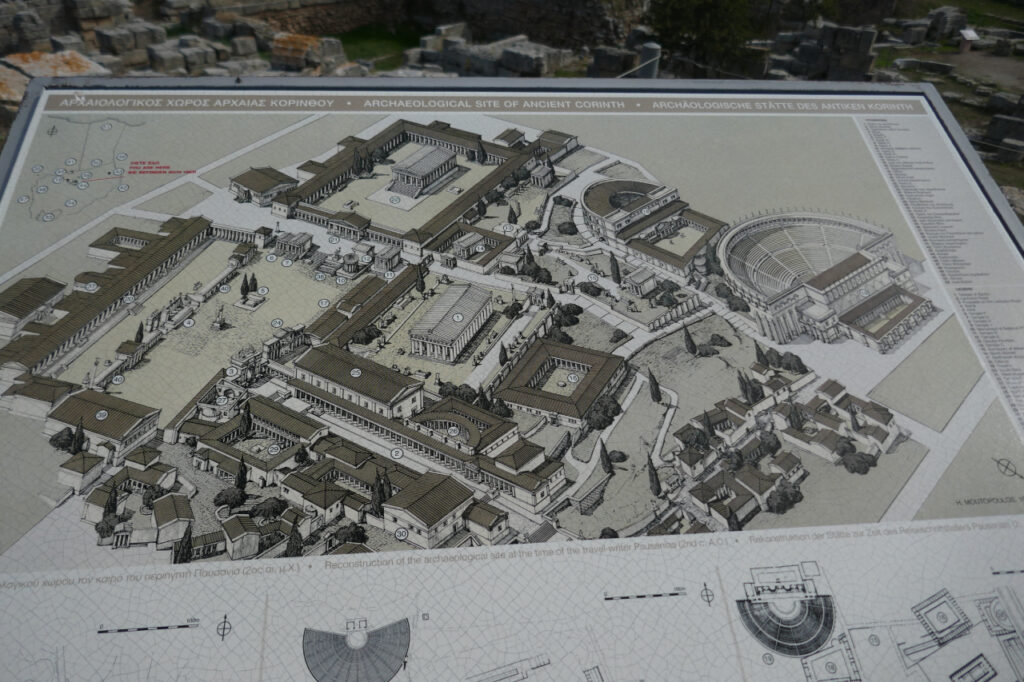
The city was a major focus of Paul’s ministry. On his first visit he stayed for about a year and a half. He returned at least twice, and he wrote at least four letters to the congregation there. We still have two of those letters, First and Second Corinthians, but scholars believe there were others that have been lost to history. (point out bema and Temple of Apollo)
Corinth itself was a fascinating place. The original city had been destroyed in 146 BCE during a revolt against Rome and for roughly a century the city lay largely in ruins until Julius Caesar refounded it as a Roman colony in 46 BCE.
The new Corinth attracted military veterans, freed slaves, merchants, craftspeople, entrepreneurs, and people looking for a fresh start. Because of the destruction of the city earlier, unlike many ancient cities there were no old established families or religious leaders with centuries of inherited privilege. Corinth was a place where people could start from scratch and move up, unencumbered by layers of social strata and obstacles.
The downside to this possibility for upward mobility was that it created a culture obsessed with status. People worked hard to climb the social ladder. There was competition over who was the most important or elevated. It is no accident that Paul repeatedly warns the Corinthians against boasting. They lived in a city where boasting was practically a civic virtue.
When Bob and I were in Corinth our guide explained to us, in a hushed voice, that with two busy ports and a constant stream of sailors, merchants, travellers, soldiers, and pilgrims moving through the city, Corinth had developed a reputation for sexual excess. The city became so famous for it that “to Corinthianize” became a Greek expression for living a morally loose life. Paul’s concerns about sexual ethics speak directly into that cultural context.
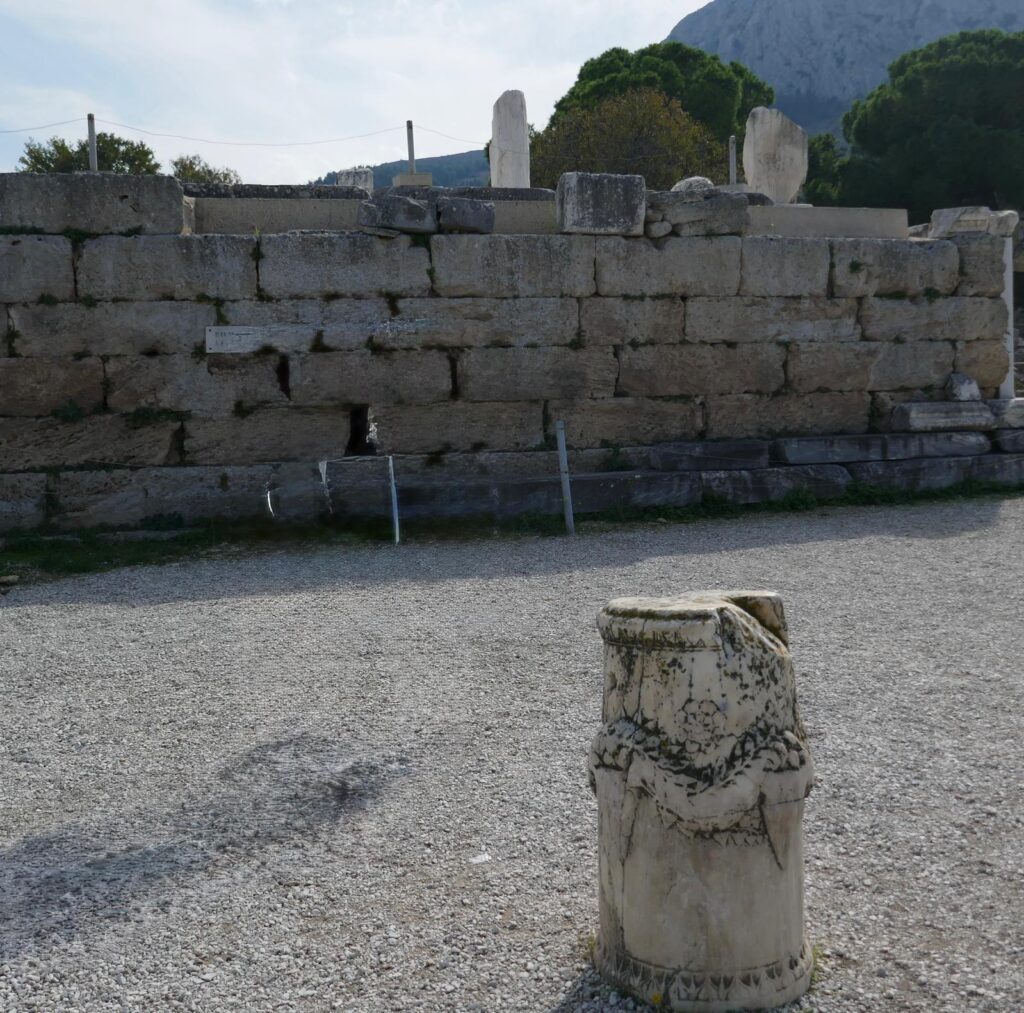
When Paul arrived in Corinth, he met Priscilla and Aquila, fellow Jews who had recently been expelled from Rome. They welcomed him into their home and together they worked as tentmakers. As usual, Paul began his ministry in the synagogue. Some people listened with interest. Others did not. Eventually opposition grew strong enough that religious leaders brought charges against him before the Roman authorities.
This photograph shows the remains of the bema, the judgment seat in Corinth. In Paul’s day it would have been a much larger structure where the Roman proconsul heard legal disputes. Tradition suggests Paul stood before that very tribunal, tied to that very post. Ultimately the Roman authorities dismissed the case as an internal religious dispute and Paul was released. But the controversy did not end there. When he left the synagogue, some people became his followers. Tensions increased as those who remained in the synagogue resented that Paul had taken with him men of some influence and financial connections. Paul’s ministry always produced two things simultaneously: deep faith and heated arguments – the situation in Corinth was no different.
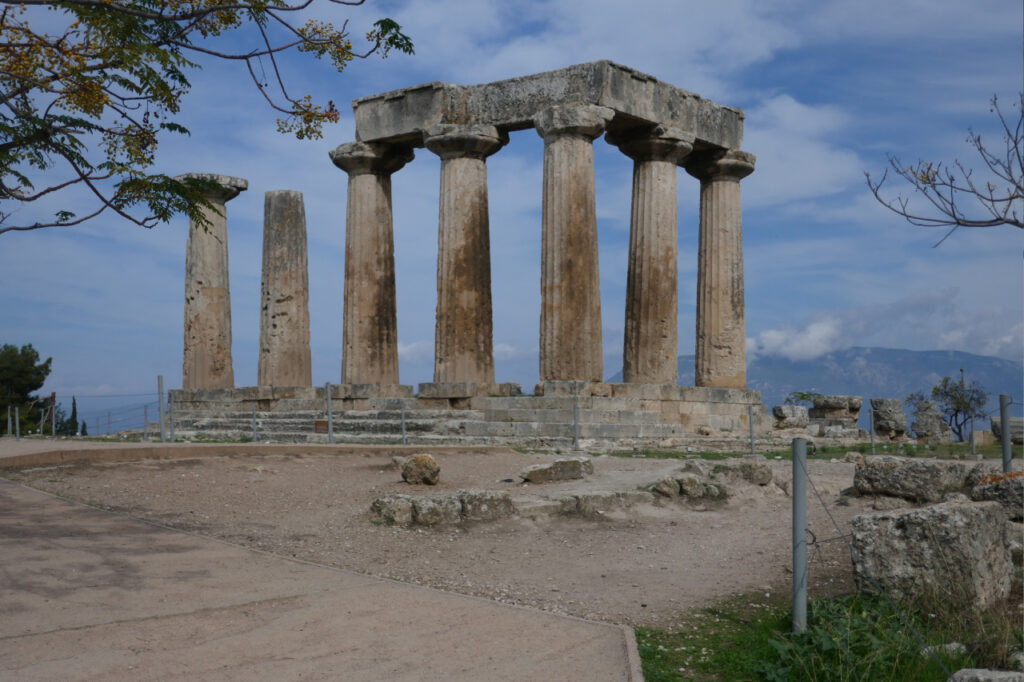
The oldest surviving structure in Corinth is the Temple of Apollo. Even today its columns dominate the landscape. Imagine what that temple represented. For most citizens it was a reassuring symbol that the gods watched over their city. It connected them to their traditions, their families, and their sense of belonging. For followers of Jesus, however, those towering columns represented a worldview they had left behind, and rather than reassurance the temple would have seemed like a reminder of the threat of censure and even violence that brooded over them.
Paul arrived in Corinth proclaiming something extraordinary. He announced that in the life, death, and resurrection of Jesus, God’s reign was breaking into the world in a new way. He proclaimed that all people stood equal before God.
As he wrote in his letter to the Galatians: “There is no longer Jew or Greek, there is no longer slave or free, there is no longer male and female; for all of you are one in Christ Jesus.”
That was a radical statement. Corinthian society depended upon distinctions. People knew their place. They knew who had power and who did not. They knew who belonged and who didn’t. And most importantly they knew who was in charge – the Romans. Paul came along and declared that those divisions no longer defined a person’s worth, and that the one and only Lord was not the Emperor, but God in Christ. In a city filled with temples, household gods, mystery religions, and eventually emperor worship, that message was profoundly disruptive.
The members of the Corinthian church were squeezed from every direction. Their neighbours thought they were abandoning the gods. Families could view them as disloyal. Political authorities became suspicious when Christians spoke of Jesus as Lord instead of Caesar. Refusing to participate in civic religious rituals could make them seem antisocial or even dangerous. Being a Christian in Corinth was not easy and the new believers struggled to know how to maintain the practices of their new religion and still somehow fit in.
Under all that external pressure, the congregation began fighting within itself. Paul hears about it from Chloe, one of his followers: “It has been reported to me by Chloe’s people that there are quarrels among you, my brothers and sisters.”
I often wonder about Paul’s reaction when he first heard the news. Was he disappointed? Frustrated? Perhaps a bit like a parent receiving a call from a teacher that begins, “I’m afraid there’s been an incident.” With three sons, my reaction would probably have been a mix of worry and a readiness to ground them for a month. Whatever his initial reaction, Paul quickly gets to the point. “Now I appeal to you, brothers and sisters, in the name of our Lord Jesus Christ, that all of you be in agreement and that there be no divisions among you.” Or paraphrased: For Christ’s sake, try to get along!
As I mentioned a couple of weeks ago, in asking the people to be of one mind Paul is not demanding that everyone think exactly alike. He is not insisting on perfect doctrinal agreement or that they all behave in the same way. What he is doing is reminding them who they are. They have forgotten their identity – baptized children of God. And they have forgotten what baptism means. In the early church, and now, baptism was not simply a welcoming ceremony. It symbolizes dying, drowning in the water of baptism and then rising with Christ. The old self has ended and a new life emerged.
He’s asking them to get along not because it’s the polite thing to do. Not because no one likes conflict. He’s asking them because baptism meant entering a new community. A new family. Baptism meant being part of the one body of Christ. But the Corinthians didn’t get it – and started arguing not about whether they were baptized but about who baptized them. Some claimed loyalty to Paul. Others to Apollos. Others to Cephas. Imagine if Susie or Lisa, baptized a couple of weeks ago, were to wonder if their baptism was somehow more authentic because it was performed by me rather than Carla. Or if they somehow were of a higher status because Carla baptized them rather than me. Yet that is exactly the sort of status competition that had infected the church. The culture of Corinth had found its way into the congregation.
And Paul has had enough and to some extent he begins to lose it. “I thank God that I baptized none of you except Crispus and Gaius…” Then he pauses. Actually, he says, I also baptized Stephanas’s household. And now that I think about it, maybe a few others. I can’t even remember now he blusters.
I love this moment because Paul’s irritation is so human, he is almost inarticulate in his frustration. But underneath all his frustration lies a deep conviction. The church is supposed to be different. “We were all baptized into one body.” All the markers that our society normally uses to sort ourselves into tribes: – Race. Nationality. Education. Income. Political affiliation. Gender. Social status – all those markers no longer define who belongs. Our primary identity becomes our participation in living in the Way of Christ, the Way of Love.
As I was writing this sermon, I found myself thinking about the welcome we offer every Sunday. Essentially, we welcome everyone who would follow in the Way of love and grace. Our words of welcome could be heard as a mission statement. They could be heard as something we aspire to become. But Paul would argue that the welcome is actually your identity statement. It is saying who you are. Because in baptism, or in our desire to follow in the Way of Love, we become one body. Whether we came from Seymour United or Deep Cove United. Whether we worship every Sunday or express our commitment through the Thrift Shop. Whether our ministry happens in the sanctuary, the garden, the kitchen, the Thrift Shop or out in the community. We belong to one another because we belong to the Way of Love.
We are one body, united in the Way of Love.
We are a welcome that is broad and deep.
We are people here for the first time and people here all the time.
We are everywhere on life’s journey.
We are old and young; we are married and single and divorced
and widowed and partnered.
We are cis and hetero and gay and lesbian and trans and two-spirited
and all the things.
We are a multiplicity of ethnicities and races and cultures.
We are Christians and people curious about Christianity.
We are a search for reconciliation and right relations.
We are one body, united in the Way of Love.
That is our one identity, lived out in multiple ways.
May it always be so. Amen